Ethiopia a Tourist Paradise
Ethiopia is truly a land of contrasts and extremes; a land of remote and wild places. Some of the highest and most stunning places on the African continent are found here, such as the jaggedly carved Simien Mountains, one of UNESCO's World Heritage Sites - and some of the lowest, such as the hot but fascinating Danakil Depression, with its sulphur fumaroles and lunar-like landscape. Ethiopia is old; old beyond all imaginations. As Abyssinia, its culture and traditions date back over 3,000 years. And far earlier than that lived "Lucy" or Dinkenesh, meaning 'thou art wonderful', as she is known to the Ethiopians, whose remains were found in a corner of this country of mystery and contrasts. Many people visit Ethiopia - or hope to do so one day - because of the remarkable manner in which ancient historical traditions have been preserved. And, indeed, the ceremonies and rituals of the Ethiopian Orthodox Church, open a window on the authentic world of the Old Testament. In no other country is it possible to find yourself so dramatically transported back in time or to participate with such freedom in the sacred rituals of an archaic faith.
MORE>>>
Natural Tourist Attractions
Ethiopia is a land of wonder and enchantment, a country with one of the richest histories on the African continent, a land of contrasts and surprises, of remote and wild places, home to cultured and friendly people who are descended from some of the world's oldest civilizations.
This is the land of the fabled Queen of Sheba, home of the Ark of the Covenant, the birthplace of Coffee. 'Lucy', the world's oldest known almost complete hominid skeleton, more than three million years old, was discovered here.
Ethiopia has so much to offer visitors: the Historic Route, covering the ancient town of Axum, with its amazing carved obelisks, Christian festivals and relics, including the Ark of the Covenant; Gondar, with its castles and palaces; Lalibela, with its remarkable rock hewn churches; and the walled Muslim city of Harar. At Dire Dawa you can see cave paintings considered to be thousands of years old.
Lake Tana, source of the Blue Nile, is one of a string of Great Rift Valley Lakes, many with national parks, home to a wealth of bird and animal life .The high, rugged, Simien Mountains in the north and the Bale Mountains in the south are also home to some unique wild life, and are ideal for trekking, whilst some of Ethiopia's fast-flowing rivers are becoming famous for white-water rafting.
Addis Ababa, Ethiopia's Capital City, has so much to offer, too, with its first-class hotels and restaurants, museums and palaces, and the Merkato-Africa's largest open-air market.Ethiopia has been called 'the land of a thousand smiles'.
The Simien Mountain National Park
The Simien Mountain Massif is one of the major highlands of Africa, rising to the highest point in Ethiopia, Ras Dejen (4620m), which is the fourth highest peak in the continent. Although in Africa and not too far from the equator, snow and ice appear on the highest points and night temperatures often fall below zero.
The national park has three general botanical regions. The lower slopes have been cultivated and grazed, while the alpine regions (up to 3600m) were forested, although much has now disappeared. The higher lands are mountain grasslands with fescue grasses as well as heathers, splendid Red Hot Pokers and Giant Lobelia.The park was created primarily to protect the indigenous Walia Ibex, a type of wild goat. Also in the park are families of the Gelada Baboon and the rare Simien fox. The over 50 species of birds have been reported in the Simein mountains.
The Blue Nile Falls (Tisisat Falls)
The river Nile, over 800 Km in length with in Ethiopia and the longest river in Africa, holds part of its heart in Ethiopia. From Lake Tana, the Blue Nile, known locally as Abbay, flows for 800 Km within Ethiopia to meet the White Nile in Khartoum to form the great river. It has been said that the Blue Nile contributes up to 80 % of the Nile's flow. Nowhere, is it more spectacular than where it thunders over the Tisisat Falls literally "Smoking Water" - near Bahir Dar. Here millions of gallons of water cascade over the cliff face and into a gorege, creating spectacular rainbows, in one of the most awe-inspiring displays in Africa.
The Blue Nile falls can easily be reached from Bahir Dar and the scenic beauty of the Blue Nile Gorge, 225 Km from Addis Ababa, can be enjoyed as part of an excursion from the capital.
The Lake Tana
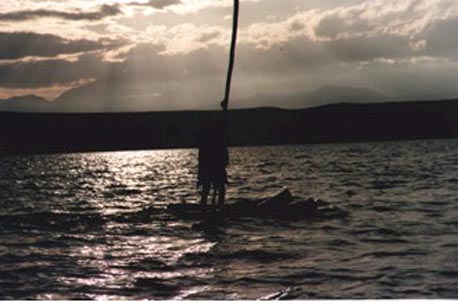
Lake Tana, the largest lake, in Ethiopia is the source and from where the famed Blue Nile starts its long journey to Khartoum, and on to the Mediterranean. The 37 islands that are scattered about the surface of the lake shelter fascinating churches and monasteries, some of which have histories dating back to the 13th century. However, it should be noted that most of the religious houses are not open to women. The most interesting islands are: Birgida Mariam, Dega Estephanos , Dek, Narga, Tana Cherkos, Mitsele Fasiledes, Kebran and Deber Maryam.
kebran Gabriel is the principal monastery visited by male tourists, with its impressive cathedral - like building first build at the end of the 17th century. Dega Estephanos, which is also closed to women, is on an island in the lake, and the monastery is reached by a very steep and winding path. Although the church is relatively new (only hundred years old), it houses a madonna painted in the 15th century. However, the treasury of the Monastery is a prime attraction, with the remains of several Emperors, as well as their robes and jewels. more>>>
Ethiopian tourism
a land of contrast and extreme diversity
Ethiopia is a land of contrast and extreme diversity. From the lowest lowland on earth to the second highest mountain in Africa, from the least complicated fascinating tribes of southern Ethiopia to the capital city and headquarter of Africa, Ethiopia is quite a contrast of historical, cultural and natural attractions.Traveling in Ethiopia is the same as traveling through time. The rich...
get more>>>
click here for photos on Ethiopian tourism
List of National Parks of Ethiopia
Semien Mountains National Park
Ethiopia is home to several national parks:
Abijatta-Shalla National Park
Awash National Park
Bale Mountains National Park
Gambela National Park
Mago National Park
Nechisar National Park
Omo National Park
Semien Mountains National Park
Yangudi Rassa National Park
Included in this system are a number of wildlife sanctuaries:
Didessa Wildlife Sanctuary
Harar Wildlife Sanctuary
Kuni-Muktar Mountain Nyala Sanctuary
Senkele Wildlife Sanctuary
Stephanie Wildlife Sanctuary
Yabelo Wildlife Sanctuary
source
Natural Parks
Ethiopia is also a land of natural contrasts, from the tops of the rugged Simien mountains to the depths of the Danakil Depression, at 120 meters below sea level one of the lowest dry land points on earth. The cornucopia of natural beauty that blesses Ethiopia offers an astonishing variety of landscapes: Afro-Alpine highlands soaring to around 4,300 meters, deserts sprinkled with salt flats and yellow sulphur, lake lands with rare and beautiful birds, moors and mountains, the splendor of the Great Rift Valley, white-water rivers, savannah teeming with game, giant waterfalls, dense and lush jungle the list is endless.
Ethiopia's many national parks enable the visitor to enjoy the country's scenery and its wildlife, conserved in natural habitats, and offer opportunities for travel adventure unparalleled in Africa.
For a cancun vacation, one needs not to get reservations on european airlines or flights to rome. They can get the essence of cancun hotels in a tropicana hotel as well.
Awash National Park
Awash National Park is the oldest and most developed wildlife reserve in Ethiopia. Featuring the 1,800-metre Fantalle Volcano, extensive mineral hot-springs and extraordinary volcanic formations, this natural treasure is bordered to the south by the Awash River and lies 225 kilometers east of the capital, Addis Ababa.
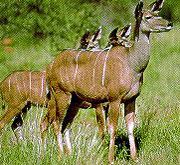
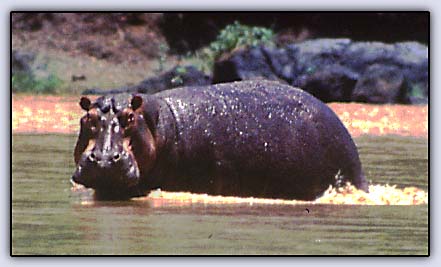
The wildlife consists mainly of East African plains animals, but there are now no giraffe or buffalo. Oryx, bat-eared fox, caracal, aardvark, colobus and green monkeys, Anubis and Hamadryas baboons, klipspringer, leopard, bushbuck, hippopotamus, Soemmering's gazelle, cheetah, lion, kudu and 450 species of bird all live within the park's 720 square kilometers.
if (navigator.appName == "Netscape")
document.write(" ");
if (navigator.appName == "Netscape")
document.write(" ");
if (navigator.appName == "Netscape")
document.write(" ");
Click here for more information.
Bale Mountains National Park
The Bale Mountains, with their vast moorlands - the lower reaches covered with St. John's wort- and their extensive heathland, virgin woodlands, pristine mountain streams and alpine climate remain an untouched and beautiful world. Rising to a height of more than 4,000 meters, the range borders Ethiopia's southern highlands, whose highest peak, Mount Tullu Deemtu, stands at 4,377 meters.
The establishment of the 2,400-square-kilometre Bale Mountains National Park was crucial to the survival of the mountain nyala, Menelik's bushbuck and the Simien red fox. This fox is one of the most colorful members of the dog family and more abundant here than anywhere else in Ethiopia. All three endemic animals thrive in this environment, the nyala in particular often being seen in large numbers. The Bale Mountains offer some fine high-altitude horse and foot trekking, and the streams of the park - which become important rivers further downstream - are well-stocked with rainbow and brown trout. Click here for more information.
Gambela National Park
The Baro River area, accessible by land or air through the western Ethiopian town of Gambela, remains a place of adventure and challenge. Traveling across the endless undulating plains of high Sudanese grass, visitors can enjoy a sense of achievement in just finding their way. This is Ethiopia's true tropical zone and here are found all the elements of the African safari, enhanced by a distinctly Ethiopian flavor.
Nile perch weighing 100 kilos can be caught in the waters of the Baro, snatched from the jaws of the huge crocodiles that thrive along the riverbank. The white-eared kob also haunts the Baro, along with other riverbank residents that include the Nile lechwe, buffalo, giraffe, tiang, waterbuck, roan antelope, zebra, bushbuck, Abyssinian reedbuck, warthog, hartebeest, lion, elephant and hippopotamus. Click here for more information.
Omo National Park
Far to the south-west lies Omo National Park, the largest in the country, with an area of 4,068 square kilometers. It is a vast expanse of true wilderness, adjacent to the Omo River, which flows southwards into Lake Turkana and is one of the richest and
least-visited wildlife sanctuaries in eastern Africa. Eland, oryx, Burchell's zebra, Lelwel hartebeest, buffalo, giraffe, elephant, waterbuck, kudu, lion, leopard and cheetah roam within the park's boundaries.
The Omo Valley is virtually free of human habitation but is rich in palaeo-anthro-pological remains. According to scientific research done in 1982 by the University of California at Berkeley, hominid remains from the Omo Valley probably date back more than four million years.
Much of Africa's volcanic activity is concentrated along the immense 5,000-kilometre crack in the earth's surface known as the Rift Valley. It is the result of two roughly parallel faults, between which, in distant geological time, the crust was weakened and the land subsided. The valley walls - daunting blue-grey ridges of volcanic basalt and granite - rise sheer on either side to towering heights of 4,000 meters. The valley floor, 50 kilometers or more across, encompasses some of the world's last true wildernesses.
Ethiopia is often referred to as the 'water tower' of eastern Africa because of the many rivers that pour off its high tableland, and a visit to this part of the Rift Valley, studded with lakes, volcanoes and savannah grassland, offers the visitor a true safari experience.
if (navigator.appName == "Netscape")
document.write(" ");
if (navigator.appName == "Netscape")
document.write(" ");
if (navigator.appName == "Netscape")
document.write(" ");
if (navigator.appName == "Netscape")
document.write(" ");
if (navigator.appName == "Netscape")
document.write(" ");
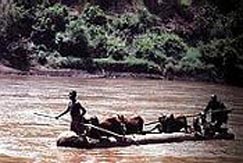
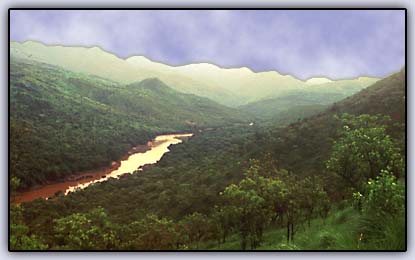
The Omo River tumbles its 350-kilometre way through a steep inaccessible valley before slowing its pace as it nears the lowlands and then meanders through flat, semi-desert bush, eventually running into Lake Turkana. Since 1973, the river has proved a major attraction for white-water rafters. The season for rafting is between September and October, when the river is still high from the June to September rains but the weather is drier.
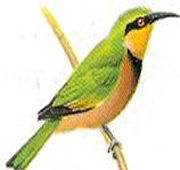
The river passes varied scenery, including an open gallery forest of tamarinds and figs, alive with colobus monkeys. Under the canopy along the riverbanks may be seen many colorful birds. Goliath herons, blue-breasted kingfishers, white-cheeked turacos, emerald-spotted wood doves and red-fronted bee-eaters are all rewarding sights, while monitor lizards may be glimpsed scuttling into the undergrowth. Beyond the forest, hippos graze on the savannah slopes against the mountain walls, and waterbuck, bushbuck and Abyssinian ground hornbills are sometimes to be seen.
Abundant wildlife, spirited rapids, innumerable side creeks and waterfalls, sheer inner canyons and hot springs all combine to make the Omo one of the world's classic river adventures.
East of the Omo River and stretching south towards the Chew Bahir basin lies the Mago National Park, rich in wildlife and with few human inhabitants. The vegetation is mainly savannah grassland and bush, extending across an area of 2,160 square kilometers. Mammal species total 81, including hartebeest, giraffe, roan antelope, elephant, lion, leopard and perhaps even a rare black rhino. Click here for more information.
Simien Mountains National Parks
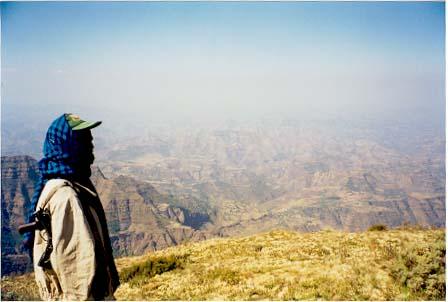
The Simien Mountain massif is a broad plateau, cut off to the north and west by an enormous single crag over 60 kilometers long. To the south, the tableland slopes gently down to 2,200 meters, divided by gorges 1,000 meters deep which can take more than two days to cross. Insufficient geological time has elapsed to smooth the contours of the crags and buttresses of hardened basalt.
Within this spectacular splendor live the Walia (Abyssinian) ibex, Simien red fox and Gelada baboon - all endemic to Ethiopia - as well as the Hamadryas baboon, klipspringer and bushbuck. Birds such as the lammergeyer, augur buzzard, Verreaux's eagle, kestrel and falcon also soar above this mountain retreat.
if (navigator.appName == "Netscape")
document.write(" ");
if (navigator.appName == "Netscape")
document.write(" ");
if (navigator.appName == "Netscape")
document.write(" ");
if (navigator.appName == "Netscape")
document.write(" ");
Twenty kilometers north-east of Gondar, the Simien Mountains National Park covers 179 square kilometers of highland area at an average elevation of 3,300 meters. Ras Dashen, at 4,620 meters the highest peak in Ethiopia, stands adjacent to the park.
The Simien escarpments, which are often compared to the Grand Canyon in the United States of America, have been adopted by Unesco as a World Heritage Site. Click here for more information.
source
Planning a Trip to Ethiopia
Abijatta-Shalla Lakes National Park Abijatta is surrounded mainly by acacia woodland, the Park covers 887 square kilometers of which 482 Square kilometers are water. Abijatta and Shalla are both terminal lakes but very different in nature. Lake Abijatta is 14 meters (46 feet) deep as opposed to Shalla which has a depth of 260 meters (853 feet).More Info
Travel information
Places to stay
What to see and do?
Awash National Park Lying in the lowlands east of Addis Ababa, and astride the Awash River, the Awash National Park is one of the finest reserves in Ethiopia. The Awash River, one of the major rivers of the Horn of Africa, waters important agricultural lands in the north-eastern part of Ethiopia and eventually flows into the wilderness of the Danakil Depression.More Info
Travel information
Places to stay
What to see and do?
Bale Mountains National ParkBale Mountains National Park is 2,400 square kilometers (1,488 square miles) in area, covering a wide range of habitats and ranging in altitude from 1,500 to 4,377 meters (4,920 to 14,357 feet). It is the highest point in southern Ethiopia.More Info
Travel information
Places to stay
What to see and do?
Dallol DepressionThe Afar area where the Ethiopian Rift Valley meets the Red Sea is one of the most inhospitable parts of the earth. Much of this area was flooded by the Red Sea, a flood that was subsequently stemmed by fresh volcanic activity that raised barriers of basaltic lava. Behind these barriers, the trapped inland sea that had formed began to evaporate under the fierce heat of the tropical sun - a process that is almost complete today.More Info
Travel information
Places to stay
What to see and do?
Gambella National ParkGambella National Park in the west of the country is unique with its large area of swamps and wetlands. The wetlands and the Baro River contain large quantities of bird life (154 species are present in the park), many of them migratory visitors. The park also contains 41 species of wildlife not found elsewhere in Ethiopia.More Info
Travel information
Places to stay
What to see and do?
Lake TanaLake Tana, the largest lake in Ethiopia, is the source of the famed Blue Nile and is where it starts its long journey to Khartoum, and then on to the Mediterranean. The 37 islands that are scattered about the surface of the lake shelter fascinating churches and monasteries. Some of which have histories dating back to the 13th century.



No comments:
Post a Comment