Ethiopia a Tourist Paradise
Ethiopia is truly a land of contrasts and extremes; a land of remote and wild places. Some of the highest and most stunning places on the African continent are found here, such as the jaggedly carved Simien Mountains, one of UNESCO's World Heritage Sites - and some of the lowest, such as the hot but fascinating Danakil Depression, with its sulphur fumaroles and lunar-like landscape. Ethiopia is old; old beyond all imaginations. As Abyssinia, its culture and traditions date back over 3,000 years. And far earlier than that lived "Lucy" or Dinkenesh, meaning 'thou art wonderful', as she is known to the Ethiopians, whose remains were found in a corner of this country of mystery and contrasts. Many people visit Ethiopia - or hope to do so one day - because of the remarkable manner in which ancient historical traditions have been preserved. And, indeed, the ceremonies and rituals of the Ethiopian Orthodox Church, open a window on the authentic world of the Old Testament. In no other country is it possible to find yourself so dramatically transported back in time or to participate with such freedom in the sacred rituals of an archaic faith.
MORE>>>
Natural Tourist Attractions
Ethiopia is a land of wonder and enchantment, a country with one of the richest histories on the African continent, a land of contrasts and surprises, of remote and wild places, home to cultured and friendly people who are descended from some of the world's oldest civilizations.
This is the land of the fabled Queen of Sheba, home of the Ark of the Covenant, the birthplace of Coffee. 'Lucy', the world's oldest known almost complete hominid skeleton, more than three million years old, was discovered here.
Ethiopia has so much to offer visitors: the Historic Route, covering the ancient town of Axum, with its amazing carved obelisks, Christian festivals and relics, including the Ark of the Covenant; Gondar, with its castles and palaces; Lalibela, with its remarkable rock hewn churches; and the walled Muslim city of Harar. At Dire Dawa you can see cave paintings considered to be thousands of years old.
Lake Tana, source of the Blue Nile, is one of a string of Great Rift Valley Lakes, many with national parks, home to a wealth of bird and animal life .The high, rugged, Simien Mountains in the north and the Bale Mountains in the south are also home to some unique wild life, and are ideal for trekking, whilst some of Ethiopia's fast-flowing rivers are becoming famous for white-water rafting.
Addis Ababa, Ethiopia's Capital City, has so much to offer, too, with its first-class hotels and restaurants, museums and palaces, and the Merkato-Africa's largest open-air market.Ethiopia has been called 'the land of a thousand smiles'.
The Simien Mountain National Park
The Simien Mountain Massif is one of the major highlands of Africa, rising to the highest point in Ethiopia, Ras Dejen (4620m), which is the fourth highest peak in the continent. Although in Africa and not too far from the equator, snow and ice appear on the highest points and night temperatures often fall below zero.
The national park has three general botanical regions. The lower slopes have been cultivated and grazed, while the alpine regions (up to 3600m) were forested, although much has now disappeared. The higher lands are mountain grasslands with fescue grasses as well as heathers, splendid Red Hot Pokers and Giant Lobelia.The park was created primarily to protect the indigenous Walia Ibex, a type of wild goat. Also in the park are families of the Gelada Baboon and the rare Simien fox. The over 50 species of birds have been reported in the Simein mountains.
The Blue Nile Falls (Tisisat Falls)
The river Nile, over 800 Km in length with in Ethiopia and the longest river in Africa, holds part of its heart in Ethiopia. From Lake Tana, the Blue Nile, known locally as Abbay, flows for 800 Km within Ethiopia to meet the White Nile in Khartoum to form the great river. It has been said that the Blue Nile contributes up to 80 % of the Nile's flow. Nowhere, is it more spectacular than where it thunders over the Tisisat Falls literally "Smoking Water" - near Bahir Dar. Here millions of gallons of water cascade over the cliff face and into a gorege, creating spectacular rainbows, in one of the most awe-inspiring displays in Africa.
The Blue Nile falls can easily be reached from Bahir Dar and the scenic beauty of the Blue Nile Gorge, 225 Km from Addis Ababa, can be enjoyed as part of an excursion from the capital.
The Lake Tana
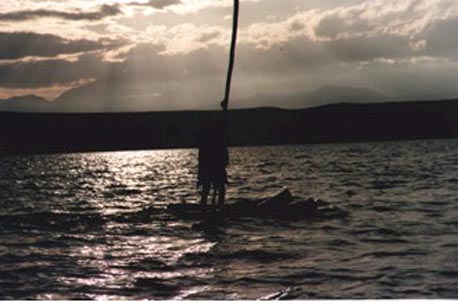
Lake Tana, the largest lake, in Ethiopia is the source and from where the famed Blue Nile starts its long journey to Khartoum, and on to the Mediterranean. The 37 islands that are scattered about the surface of the lake shelter fascinating churches and monasteries, some of which have histories dating back to the 13th century. However, it should be noted that most of the religious houses are not open to women. The most interesting islands are: Birgida Mariam, Dega Estephanos , Dek, Narga, Tana Cherkos, Mitsele Fasiledes, Kebran and Deber Maryam.
kebran Gabriel is the principal monastery visited by male tourists, with its impressive cathedral - like building first build at the end of the 17th century. Dega Estephanos, which is also closed to women, is on an island in the lake, and the monastery is reached by a very steep and winding path. Although the church is relatively new (only hundred years old), it houses a madonna painted in the 15th century. However, the treasury of the Monastery is a prime attraction, with the remains of several Emperors, as well as their robes and jewels. more>>>
Ethiopian tourism
a land of contrast and extreme diversity
Ethiopia is a land of contrast and extreme diversity. From the lowest lowland on earth to the second highest mountain in Africa, from the least complicated fascinating tribes of southern Ethiopia to the capital city and headquarter of Africa, Ethiopia is quite a contrast of historical, cultural and natural attractions.Traveling in Ethiopia is the same as traveling through time. The rich...
get more>>>
click here for photos on Ethiopian tourism
List of National Parks of Ethiopia
Semien Mountains National Park
Ethiopia is home to several national parks:
Abijatta-Shalla National Park
Awash National Park
Bale Mountains National Park
Gambela National Park
Mago National Park
Nechisar National Park
Omo National Park
Semien Mountains National Park
Yangudi Rassa National Park
Included in this system are a number of wildlife sanctuaries:
Didessa Wildlife Sanctuary
Harar Wildlife Sanctuary
Kuni-Muktar Mountain Nyala Sanctuary
Senkele Wildlife Sanctuary
Stephanie Wildlife Sanctuary
Yabelo Wildlife Sanctuary
source
Natural Parks
Ethiopia is also a land of natural contrasts, from the tops of the rugged Simien mountains to the depths of the Danakil Depression, at 120 meters below sea level one of the lowest dry land points on earth. The cornucopia of natural beauty that blesses Ethiopia offers an astonishing variety of landscapes: Afro-Alpine highlands soaring to around 4,300 meters, deserts sprinkled with salt flats and yellow sulphur, lake lands with rare and beautiful birds, moors and mountains, the splendor of the Great Rift Valley, white-water rivers, savannah teeming with game, giant waterfalls, dense and lush jungle the list is endless.
Ethiopia's many national parks enable the visitor to enjoy the country's scenery and its wildlife, conserved in natural habitats, and offer opportunities for travel adventure unparalleled in Africa.
For a cancun vacation, one needs not to get reservations on european airlines or flights to rome. They can get the essence of cancun hotels in a tropicana hotel as well.
Awash National Park
Awash National Park is the oldest and most developed wildlife reserve in Ethiopia. Featuring the 1,800-metre Fantalle Volcano, extensive mineral hot-springs and extraordinary volcanic formations, this natural treasure is bordered to the south by the Awash River and lies 225 kilometers east of the capital, Addis Ababa.
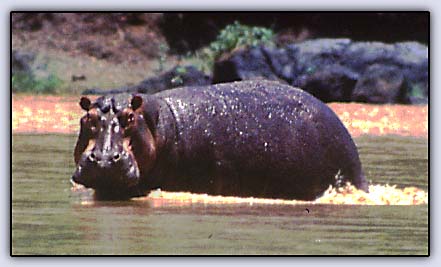
The wildlife consists mainly of East African plains animals, but there are now no giraffe or buffalo. Oryx, bat-eared fox, caracal, aardvark, colobus and green monkeys, Anubis and Hamadryas baboons, klipspringer, leopard, bushbuck, hippopotamus, Soemmering's gazelle, cheetah, lion, kudu and 450 species of bird all live within the park's 720 square kilometers.
if (navigator.appName == "Netscape")
document.write(" ");
if (navigator.appName == "Netscape")
document.write(" ");
if (navigator.appName == "Netscape")
document.write(" ");
Click here for more information.
Bale Mountains National Park
The Bale Mountains, with their vast moorlands - the lower reaches covered with St. John's wort- and their extensive heathland, virgin woodlands, pristine mountain streams and alpine climate remain an untouched and beautiful world. Rising to a height of more than 4,000 meters, the range borders Ethiopia's southern highlands, whose highest peak, Mount Tullu Deemtu, stands at 4,377 meters.
The establishment of the 2,400-square-kilometre Bale Mountains National Park was crucial to the survival of the mountain nyala, Menelik's bushbuck and the Simien red fox. This fox is one of the most colorful members of the dog family and more abundant here than anywhere else in Ethiopia. All three endemic animals thrive in this environment, the nyala in particular often being seen in large numbers. The Bale Mountains offer some fine high-altitude horse and foot trekking, and the streams of the park - which become important rivers further downstream - are well-stocked with rainbow and brown trout. Click here for more information.
Gambela National Park
The Baro River area, accessible by land or air through the western Ethiopian town of Gambela, remains a place of adventure and challenge. Traveling across the endless undulating plains of high Sudanese grass, visitors can enjoy a sense of achievement in just finding their way. This is Ethiopia's true tropical zone and here are found all the elements of the African safari, enhanced by a distinctly Ethiopian flavor.
Nile perch weighing 100 kilos can be caught in the waters of the Baro, snatched from the jaws of the huge crocodiles that thrive along the riverbank. The white-eared kob also haunts the Baro, along with other riverbank residents that include the Nile lechwe, buffalo, giraffe, tiang, waterbuck, roan antelope, zebra, bushbuck, Abyssinian reedbuck, warthog, hartebeest, lion, elephant and hippopotamus. Click here for more information.
Omo National Park
Far to the south-west lies Omo National Park, the largest in the country, with an area of 4,068 square kilometers. It is a vast expanse of true wilderness, adjacent to the Omo River, which flows southwards into Lake Turkana and is one of the richest and
least-visited wildlife sanctuaries in eastern Africa. Eland, oryx, Burchell's zebra, Lelwel hartebeest, buffalo, giraffe, elephant, waterbuck, kudu, lion, leopard and cheetah roam within the park's boundaries.
The Omo Valley is virtually free of human habitation but is rich in palaeo-anthro-pological remains. According to scientific research done in 1982 by the University of California at Berkeley, hominid remains from the Omo Valley probably date back more than four million years.
Much of Africa's volcanic activity is concentrated along the immense 5,000-kilometre crack in the earth's surface known as the Rift Valley. It is the result of two roughly parallel faults, between which, in distant geological time, the crust was weakened and the land subsided. The valley walls - daunting blue-grey ridges of volcanic basalt and granite - rise sheer on either side to towering heights of 4,000 meters. The valley floor, 50 kilometers or more across, encompasses some of the world's last true wildernesses.
Ethiopia is often referred to as the 'water tower' of eastern Africa because of the many rivers that pour off its high tableland, and a visit to this part of the Rift Valley, studded with lakes, volcanoes and savannah grassland, offers the visitor a true safari experience.
if (navigator.appName == "Netscape")
document.write(" ");
if (navigator.appName == "Netscape")
document.write(" ");
if (navigator.appName == "Netscape")
document.write(" ");
if (navigator.appName == "Netscape")
document.write(" ");
if (navigator.appName == "Netscape")
document.write(" ");
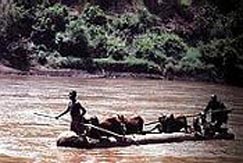
The Omo River tumbles its 350-kilometre way through a steep inaccessible valley before slowing its pace as it nears the lowlands and then meanders through flat, semi-desert bush, eventually running into Lake Turkana. Since 1973, the river has proved a major attraction for white-water rafters. The season for rafting is between September and October, when the river is still high from the June to September rains but the weather is drier.
The river passes varied scenery, including an open gallery forest of tamarinds and figs, alive with colobus monkeys. Under the canopy along the riverbanks may be seen many colorful birds. Goliath herons, blue-breasted kingfishers, white-cheeked turacos, emerald-spotted wood doves and red-fronted bee-eaters are all rewarding sights, while monitor lizards may be glimpsed scuttling into the undergrowth. Beyond the forest, hippos graze on the savannah slopes against the mountain walls, and waterbuck, bushbuck and Abyssinian ground hornbills are sometimes to be seen.
Abundant wildlife, spirited rapids, innumerable side creeks and waterfalls, sheer inner canyons and hot springs all combine to make the Omo one of the world's classic river adventures.
East of the Omo River and stretching south towards the Chew Bahir basin lies the Mago National Park, rich in wildlife and with few human inhabitants. The vegetation is mainly savannah grassland and bush, extending across an area of 2,160 square kilometers. Mammal species total 81, including hartebeest, giraffe, roan antelope, elephant, lion, leopard and perhaps even a rare black rhino. Click here for more information.
Simien Mountains National Parks
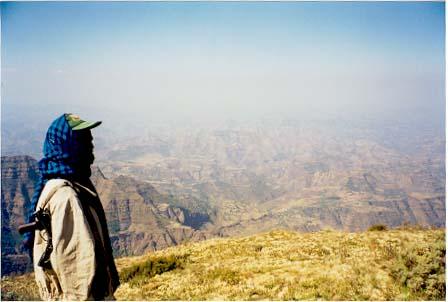
The Simien Mountain massif is a broad plateau, cut off to the north and west by an enormous single crag over 60 kilometers long. To the south, the tableland slopes gently down to 2,200 meters, divided by gorges 1,000 meters deep which can take more than two days to cross. Insufficient geological time has elapsed to smooth the contours of the crags and buttresses of hardened basalt.
Within this spectacular splendor live the Walia (Abyssinian) ibex, Simien red fox and Gelada baboon - all endemic to Ethiopia - as well as the Hamadryas baboon, klipspringer and bushbuck. Birds such as the lammergeyer, augur buzzard, Verreaux's eagle, kestrel and falcon also soar above this mountain retreat.
if (navigator.appName == "Netscape")
document.write(" ");
if (navigator.appName == "Netscape")
document.write(" ");
if (navigator.appName == "Netscape")
document.write(" ");
if (navigator.appName == "Netscape")
document.write(" ");
Twenty kilometers north-east of Gondar, the Simien Mountains National Park covers 179 square kilometers of highland area at an average elevation of 3,300 meters. Ras Dashen, at 4,620 meters the highest peak in Ethiopia, stands adjacent to the park.
The Simien escarpments, which are often compared to the Grand Canyon in the United States of America, have been adopted by Unesco as a World Heritage Site. Click here for more information.
source
Planning a Trip to Ethiopia
Abijatta-Shalla Lakes National Park Abijatta is surrounded mainly by acacia woodland, the Park covers 887 square kilometers of which 482 Square kilometers are water. Abijatta and Shalla are both terminal lakes but very different in nature. Lake Abijatta is 14 meters (46 feet) deep as opposed to Shalla which has a depth of 260 meters (853 feet).More Info
Travel information
Places to stay
What to see and do?
Awash National Park Lying in the lowlands east of Addis Ababa, and astride the Awash River, the Awash National Park is one of the finest reserves in Ethiopia. The Awash River, one of the major rivers of the Horn of Africa, waters important agricultural lands in the north-eastern part of Ethiopia and eventually flows into the wilderness of the Danakil Depression.More Info
Travel information
Places to stay
What to see and do?
Bale Mountains National ParkBale Mountains National Park is 2,400 square kilometers (1,488 square miles) in area, covering a wide range of habitats and ranging in altitude from 1,500 to 4,377 meters (4,920 to 14,357 feet). It is the highest point in southern Ethiopia.More Info
Travel information
Places to stay
What to see and do?
Dallol DepressionThe Afar area where the Ethiopian Rift Valley meets the Red Sea is one of the most inhospitable parts of the earth. Much of this area was flooded by the Red Sea, a flood that was subsequently stemmed by fresh volcanic activity that raised barriers of basaltic lava. Behind these barriers, the trapped inland sea that had formed began to evaporate under the fierce heat of the tropical sun - a process that is almost complete today.More Info
Travel information
Places to stay
What to see and do?
Gambella National ParkGambella National Park in the west of the country is unique with its large area of swamps and wetlands. The wetlands and the Baro River contain large quantities of bird life (154 species are present in the park), many of them migratory visitors. The park also contains 41 species of wildlife not found elsewhere in Ethiopia.More Info
Travel information
Places to stay
What to see and do?
Lake TanaLake Tana, the largest lake in Ethiopia, is the source of the famed Blue Nile and is where it starts its long journey to Khartoum, and then on to the Mediterranean. The 37 islands that are scattered about the surface of the lake shelter fascinating churches and monasteries. Some of which have histories dating back to the 13th century.
Saturday



Tourism in Cameroun
welcome to Cameroun at a glance
know the sites even before you visit them for your leisure
The Cameroonian government promotes the country as "Africa in miniature", asserting that the country offers all the diversity of Africa—in climate, culture, and geography—within its borders.[6] Other touristic phrases sometimes used include "the melting pot of Africa" and "Africa in microcosm".[7] Cameroon's tourist destinations are in four general areas: the coast, the major cities, the Western highlands, and the north.[8] The coast offers two major beach resort towns: Limbe is English-speaking with black, volcanic sand; and Kribi is a French-speaking city with white-sand beaches.[4] Mount Cameroon on the coast is the highest mountain in Central and West Africa and draws hikers and climbers. The stepping-off point for climbing Mt. Cameroon is the city of Buea, where guides can be hired and equipment can be rented. There are several tin-roofed huts for hikers to sleep in during their trek up the mountain.[9]
Yaoundé is home to most of Cameroon's national monuments. It also has several museums. The Western highlands offer picturesque mountain scenery, waterfalls and lakes, and the altitude provides a cooler climate. Bamenda is the main city in the western highlands, and is the capital of the Northwest province. This area is known for its traditional culture and crafts. The city of Bafoussam is especially famous for its wood-carving culture and artifacts. In fact, the area produces more crafts than any other in Cameroon. The West is also home to traditional chiefdoms and fondoms, such as the sultanate of Foumban. Each chief typically has his own palace or compound which visitors may visit for a fee.[9]
Cameroon's north is the nation's primary tourist draw.[9] The area has several wildlife reserves, including the largest and best-run in West Africa, Waza National Park.[10] These parks offer both animal viewing and big-game hunting.[11] Animals in this region include cheetahs, elephants, giraffes, hippopotami, and rhinoceroses.[1] Maroua offers a large crafts market and museums.[9]
The Adamawa, East, and South provinces offer a new front for expansion of the tourist industry, but poor transport conditions keep the industry small in these regions.[2] Forest reserves in the south have little tourist-oriented infrastructure, but visitors there may see chimpanzees, elephants, gorillas, and other rainforest fauna.[1]
click here for list of hotels in cameroun
Cameroun Tourism/North american online
LOCATION & GEOGRAPHY: Cameroon is located in Central West Africa. It is bound by Equatorial Guinea to the southwest, Gabon to the south, Congo to the southeast, the Central African Republic to the east, Chad to the northeast, Nigeria to the northwest and the Gulf of Guinea to the west. The country can be divided into four topographical zones. (1.) A low coastal plain in the south which has equatorial rain forests and swamp lands along its edges. (2.) A savannah covered plateau in its center which is known as Adamaoua Plateau. (3.) A mountainous area in the west which is covered in forests and has an active volcano called Mount Cameroon. (4.) A rolling sub arid savannah in the north. The northern zone is drained by the Logone and Chari Rivers which flow into the Lake Chad Basin. The other principal rivers are the Wouri, Sanaga, Dibamba and Nyong all of which flow into the Gulf of Guinea. Major Cities (pop. est.); Douala 810,000, Yaounde 649,000, Garoua 142,000, Maroua 123,000 (1987). Land Use; forested 77%, pastures 4%, agricultural-cultivated 15%, other 4% (1993).
CLIMATE: Cameroon has a tropical climate which varies from equatorial in the south to sahelian in the north. The sahelian climate in the north has a wet season between April and September while the rest of the year is dry. Average annual precipitation for this region is between 1,000 and 1,750 mm (39 to 69 inches). The equatorial south has two wet seasons and two dry seasons with one wet season between March and June and the great wet season between August and November while one dry season is between June and August and the great dry season is between November to March. Average temperature ranges in Yaounde are from 18 to 29 degrees Celsius (64 to 84 degrees Fahrenheit) with an average annual precipitation of 4,030 mm (159 inches).
PEOPLE: Cameroon's ethnic composition is diverse with approximately 200 ethnic groups. The principal ethnic groups consist of the Cameroon Highlanders who account for 31% of the population, the Equatorial Bantu for 19%, the Kirdi for 11%, the Fulani for 10%, the Northwestern Bantu for 8% and the Nigritic for 7%. Ethnic aliens include African tribal groups such as the Hausa, Ibo, Ewe, and Europeans which include French, German, American, British, Canadian, Greeks, Syrians, Cypriots and Lebanese.
DEMOGRAPHIC/VITAL STATISTICS: Density; 26 persons per sq km (68 persons per sq mi) (1991). Urban-Rural; 42.4% urban, 57.6% rural (1990). Sex Distribution; 49.9% male, 50.1% female (1991). Life Expectancy at Birth; 51.0 years male, 54.0 years female (1990). Age Breakdown; 46% under 15, 24% 15 to 29, 15% 30 to 44, 9% 45 to 59, 6% 60 and over (1990). Birth Rate; 47.5 per 1,000 (1990). Death Rate; 14.9 per 1,000 (1990). Increase Rate; 32.6 per 1,000 (1990). Infant Mortality Rate; 94.0 per 1,000 live births (1990).
RELIGIONS: Around 25% of the population follow local native tribal beliefs while Christians account for 53% and 22% are Muslims.
LANGUAGES: The official languages are French and English with French being the dominant. However, some 80 major African languages are spoken by the diverse ethnic tribal groups.
EDUCATION: Aged 15 or over and having attained: no formal schooling 51.1%, primary 41.7%, secondary 5.9%, higher 0.5% (1976). Literacy; literate population aged 15 or over 54.1% (1990).
MODERN HISTORY - WWII TO 1993: On Jan. 1, 1960 French Cameroon became the independent Republic of Cameroon with a presidential system of government and on June 1, 1961 British Cameroon was divided into the North and South. The northern part of British Cameroon joined with Nigeria, while the southern part joined the independent Republic of Cameroon and from then until 1972 Cameroon operated as a federation of two states East and West Cameroon. In May 1972 Cameroon adopted a new constitution that eliminated the two separate states and Cameroon was declared the United Republic of Cameroon. In 1982 Ahmadou Ahidjo resigned after 22 years as President and was replaced by Paul Biya. In 1983 Ahidjo fled to France after leading an unsuccessful coup attempt against Biya due to the fact that Ahidjo was a Muslim from the north and Biya a Christian from the south. In 1984 the Biya government crushed a coup attempt by Muslim officers from the north which resulted in the execution of around fifty officers. Later the head of state gained control over the military by delegating the Defense Ministry to his office. In 1986 some political prisoners were released and in 1987 Biya carried out economic reforms which included the reform of the public sector. In 1990 there were numerous demonstrations as well as strikes by lawyers, teachers and students in protest for democratic reforms. The protests resulted in the deaths of six marchers which forced Biya to endorse multi-partyism. In July 1990 a national conference called for the legalization of opposition parties, human rights legislation and freedom of the press. By the close of 1990 nearly all political prisoners were released. In 1991 some 25 opposition parties were legalized, although Pres. Biya refused to allow a national conference or new elections. In May 1991 after mass civil disobedience the military took control of seven provinces. In Sept. 1991 Pres. Biya suspended all political parties and closed five newspapers which resulted in a coalition of opposition leaders embarking on an international mission to convince the US, Canada and EU to withdraw support for the governing regime. Also during 1991 there were continued border clashes with Nigeria over a long-standing dispute. On Mar. 1, 1992 the RDPC won the first multiparty elections in 32 years while Pres. Biya was narrowly reelected in presidential elections held on Oct. 11, 1992, with his nearest rival John Fru Ndi being placed under house arrest immediately after the elections. Following the elections there were accusations of fraud and some violent demonstrations while the US suspended $14 million of aid. On Nov. 27, 1992 Pres. Biya reshuffled the cabinet and reappointed Simon Achidi Achu, who had become the country's first Anglophone prime minister in April 1992. In Mar. 1993 antigovernment protesters were arrested in three cities while demonstrations considered potentially violent were banned by the government. In June 1993, unpaid civil servants demonstrated while in the same month Pres. Biya government outmaneuvered their political opponents by convening a Grand National Debate on Constitutional Reform rather than opposition demands from John Fru Ndi's SDF for a Sovereign National Conference. On Aug. 10, 1993 a joint Cameroon-Nigeria border commission met in an attempt to resolve long-standing border conflicts. Also during 1993 the economic condition remained in crisis despite government curtailed budgets and civil service salary cuts.
CURRENCY: The official currency is the CFA Franc (Communiate Financiere Africaine-CFAF) divided into 100 Centimes.
ECONOMY: Gross National Product; USD $9,663,000,000 (1993). Public Debt; USD $5,683,000,000 (1993). Imports; CFAF 650,610,000,000 (1991). Exports; CFAF 788,300,000,000 (1993). Tourism Receipts; USD $47,000,000 (1993). Balance of Trade; CFAF 249,700,000,000 (1993). Economically Active Population; 4,740,000 or 40.0% of total population (1991). Unemployed; N/A.
TRANSPORT: Railroads; route length 1,104 km (686 mi) (1988), passenger-km 469,600,000 (291,796,000 passenger-mi) (1988), cargo ton-km 595,500,000 (407,858,000 short ton-mi) (1988). Roads; length 52,214 km (32,444 mi) (1987). Vehicles; cars 78,272 (1987), trucks and buses 43,868 (1987). Merchant Marine; vessels 43 (1990), deadweight tonnage 38,602 (1990). Air Transport; passenger-km 580,000,000 (360,000,000 passenger-mi) (1985), cargo ton-km 111,000,000 (76,000,000 short ton-mi) (1985).
MAIN TRADING PARTNERS: Its main trading partners are France, the USA, Germany, Japan, Italy, the Netherlands and the former USSR. MAIN PRIMARY PRODUCTS: Bauxite, Cassava, Cocoa, Coffee, Cotton, Ground Nuts, Gold, Iron Ore, Livestock, Maize, Millet, Oil and Natural Gas, Palm Oil, Plantains, Rubber, Sorghum, Sweet Potatoes, Timber, Tin, Yams. MAJOR INDUSTRIES: Agriculture, Aluminum Smelting, Beverages, Food Processing, Forestry, Mining, Shoes, Textiles, Tourism. MAIN EXPORTS: Aluminum, Cocoa, Coffee, Cotton, Petroleum, Rubber, Timber.
COMMUNICATIONS: Daily Newspapers; total of 2 with a circulation of 35,000 (1994. Radio; receivers 1,500,000 (1994). Television; receivers 15,000 (1994). Telephones; units 57,200 (1993).
source>>>
Tourism in Cameroun from wikipedia
Tourist sites

Palace of the sultan of the Bamum people in Foumban, West Province
The Cameroonian government promotes the country as "Africa in miniature", asserting that the country offers all the diversity of Africa—in climate, culture, and geography—within its borders.[6] Other touristic phrases sometimes used include "the melting pot of Africa" and "Africa in microcosm".[7] Cameroon's tourist destinations are in four general areas: the coast, the major cities, the Western highlands, and the north.[8] The coast offers two major beach resort towns: Limbe is English-speaking with black, volcanic sand; and Kribi is a French-speaking city with white-sand beaches.[4] Mount Cameroon on the coast is the highest mountain in Central and West Africa and draws hikers and climbers. The stepping-off point for climbing Mt. Cameroon is the city of Buea, where guides can be hired and equipment can be rented. There are several tin-roofed huts for hikers to sleep in during their trek up the mountain.[9]
Yaoundé is home to most of Cameroon's national monuments. It also has several museums. The Western highlands offer picturesque mountain scenery, waterfalls and lakes, and the altitude provides a cooler climate. Bamenda is the main city in the western highlands, and is the capital of the Northwest province. This area is known for its traditional culture and crafts. The city of Bafoussam is especially famous for its wood-carving culture and artifacts. In fact, the area produces more crafts than any other in Cameroon. The West is also home to traditional chiefdoms and fondoms, such as the sultanate of Foumban. Each chief typically has his own palace or compound which visitors may visit for a fee.[9]
Cameroon's north is the nation's primary tourist draw.[9] The area has several wildlife reserves, including the largest and best-run in West Africa, Waza National Park.[10] These parks offer both animal viewing and big-game hunting.[11] Animals in this region include cheetahs, elephants, giraffes, hippopotami, and rhinoceroses.[1] Maroua offers a large crafts market and museums.[9]
The Adamawa, East, and South provinces offer a new front for expansion of the tourist industry, but poor transport conditions keep the industry small in these regions.[2] Forest reserves in the south have little tourist-oriented infrastructure, but visitors there may see chimpanzees, elephants, gorillas, and other rainforest fauna.[1]
source
click here for photos on tourism in cameroun
Taurism in Kenya
The Republic of Kenya is a country in East Africa. It is bordered by Ethiopia to the north, Somalia to the northeast, Tanzania to the south, Uganda to the west, and Sudan to the northwest, with the Indian Ocean running along the southeast border. The country is named after Mount Kenya, a very significant landmark and the second among the highest mountain peaks of Africa,[4][5] and both were originally usually pronounced [ˈkiːnjə][6] in English although the native pronunciation and the one intended by the original transcription Kenia was [ˈkenia].[7] During the presidency of Jomo Kenyatta in the 1960s, the current pronunciation [ˈkɛnjə] became widespread in English too because his name was pronounced according to the original native pronunciation.[8] Before 1920, the area now known as Kenya was known as the British East Africa Protectorate and so there was no need to mention mount when referring to the mountain.[4]
more
Here are the tourist sites in Kenya
Kenya Beach Safari
Kenya’s eastern boundary is an unbroken line of blue, an azure strip of ocean lying within the protective shelter of reef.The coastline of Kenya is a tropical idyll of soft white sands and gentle sea breeze, where the passing of a day is marked by the slow arc of the sun. The pace of life on the coast is notably slower, languid, more relaxed and at peace with the world.The turquoise waters of the Indian Ocean brought Kenya’s history to exotic life, washing these shores with influences from all over the world. To explore the coast is to explore history itself, and unwind a fascinating tale written on the winding streets of the 14th Century town of Lamu, or in the bustling dhow docks of Mombasa or the ghostly ruins of Gedi, a deserted city lost deep in the jungle. Dive beneath these waters and discover an undersea paradise. The coral reefs teem with fish, a kaleidoscope of colour and life.Come ashore to beach resorts and hotels that let you relax and experience this paradise in style and comfort. Lay back and enjoy yourself, or get out and explore. Immerse yourself in a unique coastal culture as rich and rewarding as the local Swahili cuisine.Step back from the beach and discover expanses of rainforest, game rich river deltas, and much more than you ever expected.Welcome to the Kenyan coast.Take a Beach Safari…
Coast
Relaxation and Exploration on the Coast....
Kenya Sport Safari
Kenya is a great sporting nation. The name Kenya has become a byword for athletic prowess. At many recent Olympic games and other international athletic competitions, the sight of Kenyans holding the gold, silver and bronze medals for a single athletic event has become commonplace. The Kenyan love of sport means that there is plenty for the visiting sport enthusiast to see and do. This is the ideal destination for a sporting traveller.Away from the big game of our Parks and Reserves, there are plenty of other Big Games to see.From Rugby Sevens to the world's most gruelling off road Rally, there is a wide range of spectator sports throughout the year. There are also new and unusual sporting spectacles born of our exotic cultural heritage.Why not take a front row seat at the annual Donkey races in Lamu or the traditional Bullfights in Kakamega?If you don't want to just sit back and spectate, Kenya can certainly keep you busy. We take sport seriously and have world class sporting facilities to prove it.Golfers will be delighted to discover some of the finest golf courses in Africa. Tee off in our pure highland air with views of both Mt Kenya and Mt Kilimanjaro in the Distance, and discover what a real Game safari is all about.Take a sporting safari through Kenya's....
Wilderness
Take a break from the big game....
Coast
The coast of Kenya has many opportunities for the sporting traveller....
Mountains
While in the Mountains, take advantage of local sporting facilities and events...
Forests
Sporting options around the Forests...
Lakes
The ideal destination for the Sporting traveller...
Deserts
For the adventurous sportsman or woman...
Cities
The heart of Kenyan sporting life..
Kenya Adventure Safari
Kenya has long been known as an adventurer's paradise. This is a land of endless opportunity for the active traveller, a country rich with possibilities for adventure and discovery.For the Trekker, Kenya is a world of highs and lows- From the snow capped peak of Mt Kenya to the desert plains of the north. There are a range of treks from sedate hill walks through game rich ranges to high altitude routes on alpine slopes.For those aiming higher, Kenya offers plenty of challenges. Climbers may be aware of the mighty peak of Mt Kenya, but there are many other climbing areas to be explored. There is a broad scope of destinations, from granite cliffs and volcanic rock towers to the ultimate challenge- a technical assault on Africa’s second highest summit.Kenya has some excellent potential areas for off road mountain biking. As the popularity of the sport increases, more and more mountain bikes are now for hire, and there is plenty of undiscovered country for bush biking.Kenya is home to a very active equestrian community, and horses are a great way to explore wilderness areas. Riding through herds of game is an ideal way to experience the wild up close and personal. Looking for a more unusual mode of transport? The North of Kenya has a thriving camel culture, and the camel is used by many nomadic tribes. These deserts and wide arid plain lands have long been crossed by camel trains, following ancient routes through deep valleys and along winding dry river beds. Large herds of dromedary (single humped) camels are found throughout the North. A safari by camel is a unique way to see this country. The trackless deserts and high ranges of the Northern frontier are beautiful and remote places, completely isolated from the modern world. Walking through this wilderness with a camel train, camping in the wild and sleeping under the stars, you can travel through an Africa unchanged since the passage of the first explorers…Far from the northern deserts, the waters of the Indian Ocean are an adventurers playground. The coast of Kenya has a well deserved reputation for big game fishing and has attracted fishing devotees such as Ernest Hemingway, drawn by the promise of world-class fishing. Local tag and release programs ensure eco-friendly fishing.These waters have a long been a traditional passage for sailors and today dhows still ply the calm waters of the coastline. The coast is an ideal place to explore by boat, and the beaches are ideal for all kinds of watersports. Inland, the beautiful, bird rich freshwater lakes of the Rift Valley are also ideal for boating, waterskiing and windsurfing. The inland Lakes and rivers of Kenya also present plenty of opportunity for world class fishing, from Trout to the mighty Nile PerchWhite water rafting and kayaking are relatively new sports in Kenya. However, with extensive and spectacular river systems, good grade white water and wide freshwater lakes, the possibilities are boundless. Come to Kenya and begin your own great adventure story.Take an Adventure safari through our...
Wilderness
The Kenyan wilderness has long been considered one of the world's great Adventure destinations...
Coast
There's more than just relaxation to be found on the Kenyan coast...
Mountains
Looking for adventure up high? Head for the hills and Mountains..
Forest
Trek through forests in search of adventure...
Lakes
Whether you're on the water or exploring the shores, you'll find plenty of activity here
Deserts
The Northern Frontier of Kenya is regarded as Kenya's real adventure territory...
Cities
Try a one day out of town adventure...
MagicalKenya.com - the official destination website of Kenya Tourist Board
Parks & Reserves
Alphabetical Listing of Parks/Reserves
Aberdare National Park...The Aberdare National Park is part of the Aberdare Mountain Range, a fascinating region of Kenya...
Amboseli National Park...Amboseli is famous for its big game - elephants, lions and cheetahs are the main attractions - a...
Arabuko Sokoke National Park...The Arabuko Sokoke Forest Reserve near the Malindi and Watamu Reserves and Parks is the largest ...
Arawale National Reserve......
Bisanandi National Reserve...On the border of Meru National Park is Bisanadi National Reserve. Known as ‘Kinna’ the border ...
Boni National Reserve...Boni National Reserve is a 1,339sq. km forest reserve created as a sanctuary for elephants. Buff...
Buffalo Spring National Reserve...The reserve offers a unique vista of rounded hills and undulating plains. The mix of wood and gr...
Central Island National Park...Offers excellent viewing and photography and is an important breeding place for crocodiles...
Chyulu National Park...Chyulu Hills National Park was opened in January 1983 to protect its unique habitat and role as ...
Dodori National Reserve...Dodori National Reserve was opened in 1976 to preserve a breeding ground for the East Lamu Topi,...
Hell's Gate National Park...Despite its name, Hell’s Gate is an ideal family gateway for a day trip from Nairobi or stopove...
Kakamega Forest National Reserve...“A feast for the senses” said a visitor recently. Kakamega Forest National Reserve is the only...
Kamnarok National Reserve...Lake Kamnarok National Reserve opened in June 1983. It has a diverse landscape with a 4,000ft. d...
Kerio Valley National Reserve...Kerio Valley is a 4,000ft. deep valley with semi-tropical vegetation on the slopes leading down ...
Kisite-Mpunguti Marine National Park...At the southernmost point of Kenya’s 500kms coastline lie some of East Africa’s most colourful...
Kisumu Impala Wildlife Sanctuary...Kisumu Impala Wildlife Sanctuary was opened in October 1992, to protect a herd of impala and pro...
Kora National Park...Another area made famous by the Adamsons is Kora National Park. Opened in October 1989, 280kms. ...
Kuinga Marine National Reserve......
Laikipia Plateau Reserve...Laikipia Plateau Reserve was opened in October 1991. It is north-east of Laikipia district and b...
Lake Bogoria National Reserve...Most of the reserve is occupied by Lake Bogoria which is a spectacular sight, reflecting searing...
Lake Nakuru National Park...Nakuru provides the visitor with one of Kenya’s best known images. Thousands of flamingo, joine...
Losai National Reserve...Losai National Reserve was opened in January 1976. It is a wild, semi-desert landscape characte...
Maasai Mara National Reserve...The Masai Mara National Reserve is administered by the local county council. It is probably the ...
Malindi-Watamu Marine National Park...It is convenient to treat both these parks as one unit as they are incorporated in the same Mari...
Marasabit National Reserve...“This place is God’s gift” Marsabit is a forested mountain which rises spectacularly from the...
Meru National Park...Meru National Park is wild and beautiful. Straddling the equator and bisected by 13 rivers and n...
Mkogodo Forest Reserve...Mkogodo Forest Reserve is a belt of riverine forest along the Ngare Ndare River. It is the homel...
Mombasa Marine National Park...Mombasa Marine Reserve was formed first, to protect the previous coralheads and their resident m...
Mount Elgon National Park...Mt. Elgon, on the Kenya/Uganda border is a volcanic mountain, formed when the earth’s crust eru...
Mount Kenya National Park...AT 5,199m high, Mt. Kenya is East Africa’s second highest mountain. It offers easy or challengi...
Mammals
Listing of Mammals in Alphabetical order
Baboon
(Papio cyanocephalus) - ...The Baboon, Papio cyanocephalus, is a large terrestrial monkey with a somewhat dog-like head. Th...
Black and White Colobus
(Colobus guereza ) - ...The Black and White Colobus Colobus guereza also known as the Guereza is a very distinctive and ...
Black Rhinoceros
(Diceros bicornis) - ...The Black Rhino has a hooked and flexible upper lip. It feeds on leaves, shoots and buds. Black ...
Cape Buffalo
(Syncerus caffer) - ...The Cape Buffalo, Syncerus caffer, is a massive, moody and very dangerous animal. Their main die...
Cape Hare
(Lepus capensis) - ...The Cape Hare, Lepus capensis, is primarily vegetarian but also occasionally eats mice. They inc...
Listing of Mammals in Alphabetical order
Cape Hare
(Lepus capensis) - ...The Cape Hare, Lepus capensis, is primarily vegetarian but also occasionally eats mice. They inc...
Cheetah
(Acinonyx jubatus) - ...One of the world's fastest land animals, the Cheetah, Acinonyx jubatus, is another solitary cat....
Coke's Hartebeest
(Alcelaphus bucelaphus) - ...Coke's Hartebeest Alcelaphus bucelaphus, also known as the Kongoni, has the distinctive "Hartebe...
Common Zebra
(Hippotigris quagga ) - ...There are 2 species of Zebra found in Kenya, the Common Zebra, Hippotigris quagga and Grevy's Ze...
Eastern Dwarf Mongoose
(Helogale undulata) - ...The Eastern Dwarf Mongoose, Helogale undulata, is a social animal travelling in
Kenya's Forests
Kenya has a wide range of forests, from coastal forest, through central high mountain forests to the thick wet rainforests of the West. These forests support more than just a diverse range of tree and plant species; they are also the territory of a wide range of wildlife, from rare chameleons to elephant herds, elusive leopards to colourful butterflies, monkey families and prolific birdlife.Kenyan forests offer the traveller a wide range of options, from treetop lodges to trekking trails …
Kakamega
This thick equatorial jungle is a haven for birds, reptiles, and a remarkable range of monkeys …
Aberdares
The salient forests and moorlands of this highland range are home to Elephant, Buffalo, Rhino, and much more ...
Arabuko Sokoke
This coastal forest offers the visitor the chance to encounter several unusual species of bird and small mammals, and a glorious range of butterflies …
Mt Kenya Forests
In the Shadow of Kenya’s highest peak, the dense highland forests are alive with game …
Kenya's Desert Wilderness
The North of Kenya is a vast trackless expanse of desert and semi desert wilderness. This hot, sparsely populated land is a place of harsh and stunning beauty. Among the stunning cliffs and ranges and thorn scrub of the North, live some of Kenya’s last nomadic tribes. For these people, the desert wilderness is an integral part of their lives, and they cross these lands with camel trains following traditional routes older than any living memory.For many people, this is the real Kenya, where the great empty spaces hold the promise of real adventure ...
Maralal and Beyond
This frontier town is the gateway to the great Northern wilderness ...
Marsabit and Beyond
A beautiful oasis of green set high above the desert floor, Marsabit is surrounded by pristine wilderness, and countless elephants
Kenya's Historical Cities
Kenya’s two largest cities have all played a vital role in the nations eventful history.Mombasa is an island city whose magnificent fort and harbour have been centre stage for hundreds of years of turbulent history.The beginning of the 20th century saw a railroad begin to wind its way from this port town inwards towards central Africa. The railroad made it first distant outpost in a swampy highland plain that became the small town of Nairobi, now the Kenya's busy modern capital.The rail link between the two cities forged a link of national unity and become the lifeblood of Kenya.Together these two cities paint a vivid portrait of Kenya. They create a diverse melting pot of races and traditional and modern cultures, with a history as rich as the natural wealth of the country itself.
Nairobi
Nairobi may be outgrowing its roots as a colonial frontier town, but it remains a lively and compelling mix of cultures, commerce and community …
Mombasa
One of the world’s most exotic tropical ports, Mombasa’s busy Dhow harbour and bustling streets tell of a long and fascinating history ...
click here to view photos on Kenya's tourism potentials
source
other links to tourism in kenya
kenya.rcbowen.com
www.infoplease.com/ipa/A0107678.html
www.weebls-stuff.com/toons/kenya
more
Here are the tourist sites in Kenya
Kenya Beach Safari
Kenya’s eastern boundary is an unbroken line of blue, an azure strip of ocean lying within the protective shelter of reef.The coastline of Kenya is a tropical idyll of soft white sands and gentle sea breeze, where the passing of a day is marked by the slow arc of the sun. The pace of life on the coast is notably slower, languid, more relaxed and at peace with the world.The turquoise waters of the Indian Ocean brought Kenya’s history to exotic life, washing these shores with influences from all over the world. To explore the coast is to explore history itself, and unwind a fascinating tale written on the winding streets of the 14th Century town of Lamu, or in the bustling dhow docks of Mombasa or the ghostly ruins of Gedi, a deserted city lost deep in the jungle. Dive beneath these waters and discover an undersea paradise. The coral reefs teem with fish, a kaleidoscope of colour and life.Come ashore to beach resorts and hotels that let you relax and experience this paradise in style and comfort. Lay back and enjoy yourself, or get out and explore. Immerse yourself in a unique coastal culture as rich and rewarding as the local Swahili cuisine.Step back from the beach and discover expanses of rainforest, game rich river deltas, and much more than you ever expected.Welcome to the Kenyan coast.Take a Beach Safari…
Coast
Relaxation and Exploration on the Coast....
Kenya Sport Safari
Kenya is a great sporting nation. The name Kenya has become a byword for athletic prowess. At many recent Olympic games and other international athletic competitions, the sight of Kenyans holding the gold, silver and bronze medals for a single athletic event has become commonplace. The Kenyan love of sport means that there is plenty for the visiting sport enthusiast to see and do. This is the ideal destination for a sporting traveller.Away from the big game of our Parks and Reserves, there are plenty of other Big Games to see.From Rugby Sevens to the world's most gruelling off road Rally, there is a wide range of spectator sports throughout the year. There are also new and unusual sporting spectacles born of our exotic cultural heritage.Why not take a front row seat at the annual Donkey races in Lamu or the traditional Bullfights in Kakamega?If you don't want to just sit back and spectate, Kenya can certainly keep you busy. We take sport seriously and have world class sporting facilities to prove it.Golfers will be delighted to discover some of the finest golf courses in Africa. Tee off in our pure highland air with views of both Mt Kenya and Mt Kilimanjaro in the Distance, and discover what a real Game safari is all about.Take a sporting safari through Kenya's....
Wilderness
Take a break from the big game....
Coast
The coast of Kenya has many opportunities for the sporting traveller....
Mountains
While in the Mountains, take advantage of local sporting facilities and events...
Forests
Sporting options around the Forests...
Lakes
The ideal destination for the Sporting traveller...
Deserts
For the adventurous sportsman or woman...
Cities
The heart of Kenyan sporting life..
Kenya Adventure Safari
Kenya has long been known as an adventurer's paradise. This is a land of endless opportunity for the active traveller, a country rich with possibilities for adventure and discovery.For the Trekker, Kenya is a world of highs and lows- From the snow capped peak of Mt Kenya to the desert plains of the north. There are a range of treks from sedate hill walks through game rich ranges to high altitude routes on alpine slopes.For those aiming higher, Kenya offers plenty of challenges. Climbers may be aware of the mighty peak of Mt Kenya, but there are many other climbing areas to be explored. There is a broad scope of destinations, from granite cliffs and volcanic rock towers to the ultimate challenge- a technical assault on Africa’s second highest summit.Kenya has some excellent potential areas for off road mountain biking. As the popularity of the sport increases, more and more mountain bikes are now for hire, and there is plenty of undiscovered country for bush biking.Kenya is home to a very active equestrian community, and horses are a great way to explore wilderness areas. Riding through herds of game is an ideal way to experience the wild up close and personal. Looking for a more unusual mode of transport? The North of Kenya has a thriving camel culture, and the camel is used by many nomadic tribes. These deserts and wide arid plain lands have long been crossed by camel trains, following ancient routes through deep valleys and along winding dry river beds. Large herds of dromedary (single humped) camels are found throughout the North. A safari by camel is a unique way to see this country. The trackless deserts and high ranges of the Northern frontier are beautiful and remote places, completely isolated from the modern world. Walking through this wilderness with a camel train, camping in the wild and sleeping under the stars, you can travel through an Africa unchanged since the passage of the first explorers…Far from the northern deserts, the waters of the Indian Ocean are an adventurers playground. The coast of Kenya has a well deserved reputation for big game fishing and has attracted fishing devotees such as Ernest Hemingway, drawn by the promise of world-class fishing. Local tag and release programs ensure eco-friendly fishing.These waters have a long been a traditional passage for sailors and today dhows still ply the calm waters of the coastline. The coast is an ideal place to explore by boat, and the beaches are ideal for all kinds of watersports. Inland, the beautiful, bird rich freshwater lakes of the Rift Valley are also ideal for boating, waterskiing and windsurfing. The inland Lakes and rivers of Kenya also present plenty of opportunity for world class fishing, from Trout to the mighty Nile PerchWhite water rafting and kayaking are relatively new sports in Kenya. However, with extensive and spectacular river systems, good grade white water and wide freshwater lakes, the possibilities are boundless. Come to Kenya and begin your own great adventure story.Take an Adventure safari through our...
Wilderness
The Kenyan wilderness has long been considered one of the world's great Adventure destinations...
Coast
There's more than just relaxation to be found on the Kenyan coast...
Mountains
Looking for adventure up high? Head for the hills and Mountains..
Forest
Trek through forests in search of adventure...
Lakes
Whether you're on the water or exploring the shores, you'll find plenty of activity here
Deserts
The Northern Frontier of Kenya is regarded as Kenya's real adventure territory...
Cities
Try a one day out of town adventure...
MagicalKenya.com - the official destination website of Kenya Tourist Board
Parks & Reserves
Alphabetical Listing of Parks/Reserves
Aberdare National Park...The Aberdare National Park is part of the Aberdare Mountain Range, a fascinating region of Kenya...
Amboseli National Park...Amboseli is famous for its big game - elephants, lions and cheetahs are the main attractions - a...
Arabuko Sokoke National Park...The Arabuko Sokoke Forest Reserve near the Malindi and Watamu Reserves and Parks is the largest ...
Arawale National Reserve......
Bisanandi National Reserve...On the border of Meru National Park is Bisanadi National Reserve. Known as ‘Kinna’ the border ...
Boni National Reserve...Boni National Reserve is a 1,339sq. km forest reserve created as a sanctuary for elephants. Buff...
Buffalo Spring National Reserve...The reserve offers a unique vista of rounded hills and undulating plains. The mix of wood and gr...
Central Island National Park...Offers excellent viewing and photography and is an important breeding place for crocodiles...
Chyulu National Park...Chyulu Hills National Park was opened in January 1983 to protect its unique habitat and role as ...
Dodori National Reserve...Dodori National Reserve was opened in 1976 to preserve a breeding ground for the East Lamu Topi,...
Hell's Gate National Park...Despite its name, Hell’s Gate is an ideal family gateway for a day trip from Nairobi or stopove...
Kakamega Forest National Reserve...“A feast for the senses” said a visitor recently. Kakamega Forest National Reserve is the only...
Kamnarok National Reserve...Lake Kamnarok National Reserve opened in June 1983. It has a diverse landscape with a 4,000ft. d...
Kerio Valley National Reserve...Kerio Valley is a 4,000ft. deep valley with semi-tropical vegetation on the slopes leading down ...
Kisite-Mpunguti Marine National Park...At the southernmost point of Kenya’s 500kms coastline lie some of East Africa’s most colourful...
Kisumu Impala Wildlife Sanctuary...Kisumu Impala Wildlife Sanctuary was opened in October 1992, to protect a herd of impala and pro...
Kora National Park...Another area made famous by the Adamsons is Kora National Park. Opened in October 1989, 280kms. ...
Kuinga Marine National Reserve......
Laikipia Plateau Reserve...Laikipia Plateau Reserve was opened in October 1991. It is north-east of Laikipia district and b...
Lake Bogoria National Reserve...Most of the reserve is occupied by Lake Bogoria which is a spectacular sight, reflecting searing...
Lake Nakuru National Park...Nakuru provides the visitor with one of Kenya’s best known images. Thousands of flamingo, joine...
Losai National Reserve...Losai National Reserve was opened in January 1976. It is a wild, semi-desert landscape characte...
Maasai Mara National Reserve...The Masai Mara National Reserve is administered by the local county council. It is probably the ...
Malindi-Watamu Marine National Park...It is convenient to treat both these parks as one unit as they are incorporated in the same Mari...
Marasabit National Reserve...“This place is God’s gift” Marsabit is a forested mountain which rises spectacularly from the...
Meru National Park...Meru National Park is wild and beautiful. Straddling the equator and bisected by 13 rivers and n...
Mkogodo Forest Reserve...Mkogodo Forest Reserve is a belt of riverine forest along the Ngare Ndare River. It is the homel...
Mombasa Marine National Park...Mombasa Marine Reserve was formed first, to protect the previous coralheads and their resident m...
Mount Elgon National Park...Mt. Elgon, on the Kenya/Uganda border is a volcanic mountain, formed when the earth’s crust eru...
Mount Kenya National Park...AT 5,199m high, Mt. Kenya is East Africa’s second highest mountain. It offers easy or challengi...
Mammals
Listing of Mammals in Alphabetical order
Baboon
(Papio cyanocephalus) - ...The Baboon, Papio cyanocephalus, is a large terrestrial monkey with a somewhat dog-like head. Th...
Black and White Colobus
(Colobus guereza ) - ...The Black and White Colobus Colobus guereza also known as the Guereza is a very distinctive and ...
Black Rhinoceros
(Diceros bicornis) - ...The Black Rhino has a hooked and flexible upper lip. It feeds on leaves, shoots and buds. Black ...
Cape Buffalo
(Syncerus caffer) - ...The Cape Buffalo, Syncerus caffer, is a massive, moody and very dangerous animal. Their main die...
Cape Hare
(Lepus capensis) - ...The Cape Hare, Lepus capensis, is primarily vegetarian but also occasionally eats mice. They inc...
Listing of Mammals in Alphabetical order
Cape Hare
(Lepus capensis) - ...The Cape Hare, Lepus capensis, is primarily vegetarian but also occasionally eats mice. They inc...
Cheetah
(Acinonyx jubatus) - ...One of the world's fastest land animals, the Cheetah, Acinonyx jubatus, is another solitary cat....
Coke's Hartebeest
(Alcelaphus bucelaphus) - ...Coke's Hartebeest Alcelaphus bucelaphus, also known as the Kongoni, has the distinctive "Hartebe...
Common Zebra
(Hippotigris quagga ) - ...There are 2 species of Zebra found in Kenya, the Common Zebra, Hippotigris quagga and Grevy's Ze...
Eastern Dwarf Mongoose
(Helogale undulata) - ...The Eastern Dwarf Mongoose, Helogale undulata, is a social animal travelling in
Kenya's Forests
Kenya has a wide range of forests, from coastal forest, through central high mountain forests to the thick wet rainforests of the West. These forests support more than just a diverse range of tree and plant species; they are also the territory of a wide range of wildlife, from rare chameleons to elephant herds, elusive leopards to colourful butterflies, monkey families and prolific birdlife.Kenyan forests offer the traveller a wide range of options, from treetop lodges to trekking trails …
Kakamega
This thick equatorial jungle is a haven for birds, reptiles, and a remarkable range of monkeys …
Aberdares
The salient forests and moorlands of this highland range are home to Elephant, Buffalo, Rhino, and much more ...
Arabuko Sokoke
This coastal forest offers the visitor the chance to encounter several unusual species of bird and small mammals, and a glorious range of butterflies …
Mt Kenya Forests
In the Shadow of Kenya’s highest peak, the dense highland forests are alive with game …
Kenya's Desert Wilderness
The North of Kenya is a vast trackless expanse of desert and semi desert wilderness. This hot, sparsely populated land is a place of harsh and stunning beauty. Among the stunning cliffs and ranges and thorn scrub of the North, live some of Kenya’s last nomadic tribes. For these people, the desert wilderness is an integral part of their lives, and they cross these lands with camel trains following traditional routes older than any living memory.For many people, this is the real Kenya, where the great empty spaces hold the promise of real adventure ...
Maralal and Beyond
This frontier town is the gateway to the great Northern wilderness ...
Marsabit and Beyond
A beautiful oasis of green set high above the desert floor, Marsabit is surrounded by pristine wilderness, and countless elephants
Kenya's Historical Cities
Kenya’s two largest cities have all played a vital role in the nations eventful history.Mombasa is an island city whose magnificent fort and harbour have been centre stage for hundreds of years of turbulent history.The beginning of the 20th century saw a railroad begin to wind its way from this port town inwards towards central Africa. The railroad made it first distant outpost in a swampy highland plain that became the small town of Nairobi, now the Kenya's busy modern capital.The rail link between the two cities forged a link of national unity and become the lifeblood of Kenya.Together these two cities paint a vivid portrait of Kenya. They create a diverse melting pot of races and traditional and modern cultures, with a history as rich as the natural wealth of the country itself.
Nairobi
Nairobi may be outgrowing its roots as a colonial frontier town, but it remains a lively and compelling mix of cultures, commerce and community …
Mombasa
One of the world’s most exotic tropical ports, Mombasa’s busy Dhow harbour and bustling streets tell of a long and fascinating history ...
click here to view photos on Kenya's tourism potentials
source
other links to tourism in kenya
kenya.rcbowen.com
www.infoplease.com/ipa/A0107678.html
www.weebls-stuff.com/toons/kenya
Subscribe to:
Comments (Atom)